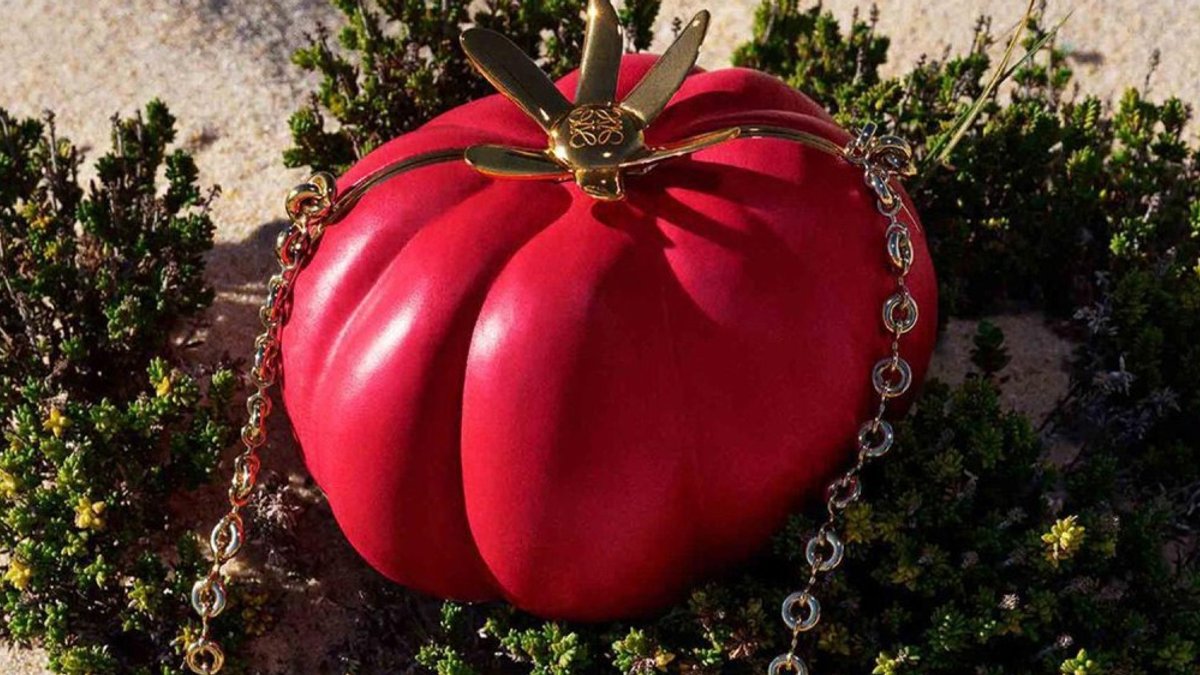
Fashion has long found inspiration from the culinary world, but the influx of food-fueled prints, graphics, and trompe l’oeil accessories has now reached a cultural tipping point. The trend, which picked up steam during the pandemic, has resulted in countless examples of food motifs and edible, wearable trompe l’oeil creations at all price points.
Loewe’s summer collection featured a $4,150 lambskin tomato clutch, while Walmart’s included a line of rotisserie chicken bag-like purses and charms starting at $5.97. This trajectory started in high fashion and worked its way down to mass-market ubiquity.
In 2020, a chocolate chip cookie went down one of New York Fashion Week’s most buzzed-about fall runways, protruding from a black purse by the designer Puppets and Puppets. The design quickly went viral for its whimsical inclusion of a classic dessert on a high-end handbag.
Food as a Central Theme
Puppets designer Carly Mark made food a central theme of her vision, with designs such as cake-topped aviator caps, Ferrero Rocher heels, and beeswax-sculpted cheese hats. These hyperrealistic, absurdist food designs are capable of achieving instant social media virality.
Mark, who previously worked as an artist whose pieces revolved around candies and snacks, told Business of Fashion in 2023 that the Puppets universe felt like the ideal pairing given what she considers food and fashion’s motivators: pleasure and money.
The trend has also been driven by social media, with the “strawberry dress” taking over TikTok during the pandemic, and Tombolo Company finding a hit with its vongole shirt, which debuted in 2019 but found peak popularity in 2021.
The Roots of the Trend
The concept of “foodies” was new in the 2000s and 2010s, with brands printing tongue-in-cheek food– and coffee-related motifs and slogans on hipster apparel. This period was a key stepping stone in the evolution toward the far more elaborate and pervasive marketability of food-as-identity we see today.
Content creator Cole Poska notes that “food brands have something most brands would kill for: decades of nostalgia, iconic identities, and consumers who are borderline obsessed with them.” Poska’s own Instagram often reimagines restaurant merch, and his designs for Cheesecake Factory apparel have gone viral.
However, the fatigue is undoubtedly here, with many noting that the novelty factor of a shrimp-print dress has worn off. The next question might be: Will there be any true longevity for these food-as-fashion moments?
Read Also: Yelp’s Fake Review Alerts Cause Long-Term Restaurant Traffic Drops
As the trend continues to evolve, it’s possible that a more subtle approach may be necessary to escape the sense of accelerated-trend-cycle disposability. Sam Salad, co-founder of Meals, a Los Angeles-based apparel company, notes that “design today has to translate across languages and platforms.”
Salad’s company, which “bakes ‘food culture’ into apparel, blurring the lines between the clothes we eat and the food we wear,” offers a classic chef pant with a slightly fuller cut, in both basic colors and subdued aesthetic homages to blue cheese and watermelon.
Poska’s philosophy is similar, stating that he would rather make one thing people talk about for a year than 20 things people forget about tomorrow. This approach may be the key to creating food-themed fashion that is more than just a fleeting trend.
A $425 cardigan emblazoned with oysters may be seen as a status symbol, indicating that the wearer is financially comfortable and well-fed.
As Salad notes, “food is totally universal,” and its incorporation into fashion is not new, even if today’s hyper-fast trend cycle has kicked it into overdrive.
As Poska says, “the first person to make a candle look like a stick of butter is a genius. The hundredth person is just making a candle.”
A More Subtle Approach
Food is hardly a new bedfellow for fashion designers, with examples such as Issey Miyake’s pleats collection being merchandised as little omakase sets. The iconic Salvador Dalí- and Elsa Schiaparelli-designed lobster dress is another example of successful food-meets-fashion moments.
Today, the spawn of such designs are available on websites like Shein for $13, highlighting the need for brands to focus on quality and storytelling rather than quantity and gimmicks. The market is saturated with food-themed fashion, and it’s up to brands to create a lasting impact.
