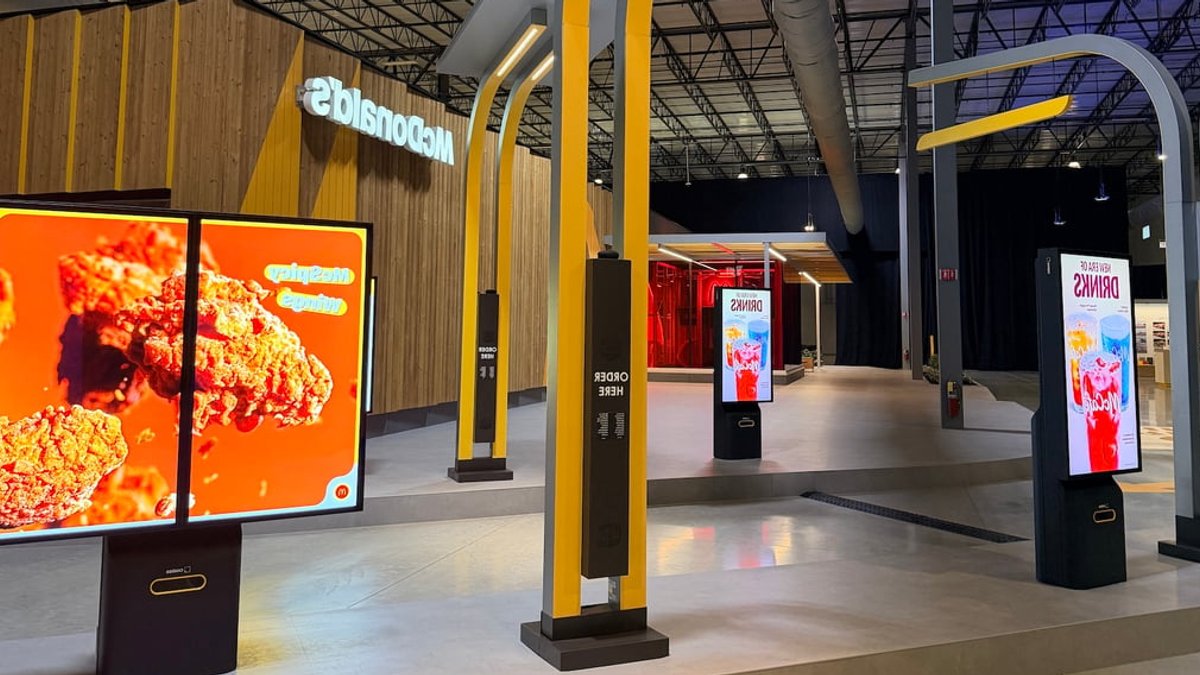
McDonald’s is testing a new strategy to monetize its drive-thru menu boards by displaying advertisements at about 450 locations in the United States. The company’s Investor Day event featured a Geico advertisement on a drive-thru screen, marking the first public demonstration of this concept. Morgan Flatley, the global chief marketing officer, emphasized that the approach generates revenue with minimal cost, no operational disruptions, and no changes to the customer experience. The test is part of a broader effort to create a commerce media network, where McDonald’s leverages its vast physical footprint to sell ad space to non-competing businesses.
Ad networks tied to retail spaces are growing rapidly. Market research firm EMarketer predicts U.S. spending on these networks will surpass $100 billion by 2028. Major retailers like Amazon, Walmart, Target, Kroger, and Instacart already operate similar programs, while convenience chains such as 7-Eleven, Wawa, Circle K, and Kwik Trip have also adopted this model. Walmart’s platform, Walmart Connect, generated $6.4 billion in revenue last year and expanded by 43% in its most recent quarter, demonstrating the financial potential of such networks.
Few restaurant chains have launched comparable ad networks, with exceptions like Topgolf and Chuck E. Cheese. McDonald’s estimates its own network could eventually produce around $1 billion annually. With over 46,000 locations worldwide, including 13,700 in the U.S., the company serves approximately 70 million customers daily. Ian Borden, chief financial officer, noted that the brand reaches about 85% of the U.S. population at least once a year, making its physical spaces highly valuable for targeted advertising. The company’s global reach and frequent customer interactions position it uniquely to capitalize on this trend.
The test includes digital screens in dining areas and on drive-thru boards, allowing large-format ads from non-competing businesses. This would transform McDonald’s physical spaces into a digital billboard network, with ads appearing while customers order. Since 95% of its restaurants are franchise-owned, the company is initially testing only corporate-run stores to evaluate feasibility and revenue-sharing models. Franchisees could benefit from additional income, but the company has not yet determined how ad revenue would be distributed or what contractual obligations franchisees might face.
Customers will encounter ads while ordering, though the company insists the overall experience will remain unchanged. The added screens could offer local businesses a low-cost way to reach high-traffic areas without disrupting dining operations. Borden emphasized that the current phase focuses on learning how to execute the concept effectively. “Right now we’re just learning, and we’re learning in company restaurants because we’ve got to figure out if we have an opportunity,” he stated. The prototype includes multiple potential ad placements, such as dining room screens, which could further expand revenue opportunities.
